TRACE: Forms that do not close
Jieun Cheon · Ruoxi Hua · Mina Kim
Yena Park · Evan Peltzman · Moyan Sun
June 12 – July 18, 2026
Reception: Friday, June 12, 6-8 pm
150-24 Northern Blvd., Suite G5, Flushing NY

Jakupsil presents TRACE: Forms That Do Not Close, an exhibition of recent work by six New York-based artists across painting, object, installation, and mixed media. The exhibition turns its attention to what persists after the structures that once organized our lives have given way — not vanished, but continuing in altered form. Memory, material, body, and space endure through rupture and change, and the works explore the layers of meaning that accumulate in the aftermath. Meaning here is not delivered as conclusion. It builds slowly — through repeated action, through the weight of lived time pressing into surface and material, through memory operating not as fixed record but as something that continues to act on perception long after its origin has passed.
The exhibition moves through threshold spaces where comprehension meets its limits, order gives way to chaos, intimacy shades into estrangement, presence into absence. A speculative world built from systems of belief strains against the gap between perception and reality; urban spaces register anonymity and estrangement with cold precision; structures built from years of labor carry the traces of displacement and the persistence of care and survival; surfaces layered with noise, obstruction, and memory hold the coexistence of past and present; figures dissolve into shifting psychological spaces where emotional residue persists long after connection has faded; and material fields keep shifting through cycles of expansion and dissolution long after the hand has withdrawn. Memory materializes not as image but as force — what Ricœur understood as the trace: the living residue of what was, still actively shaping the present. The body, as Merleau-Ponty insisted, is never merely the instrument of making; it is the site where form discovers itself through sustained physical encounter. These works exist closer to the process of becoming than to any finished state.
Jieun Cheon constructs a speculative world by combining mythological imagery, religious iconography, and scientific reference — exploring the limits of rational understanding and comprehension. Her ongoing series Uncanished Workld — An Epistemological Inquiry navigates the tension between order and chaos, belief and knowledge, construction and decay, presenting a world that can be described through language but never fully contained, remaining in a state of perpetual incompletion. Where Cheon builds worlds at the edge of what language can hold, Mina Kim begins where language fails altogether. Using wire salvaged from her father's garage and plastic twist-ties from her mother's kitchen drawer — modest materials from intimate domestic spaces — she constructs hand-formed structures that hover between shelter and cage. Repetition functions not only as construction but as contemplative practice: through sustained labor, the work becomes a ritual process in which thought recedes and attention shifts fully to the act itself. Grounded in experiences of migration and cultural displacement — suspended between two cultural logics, simultaneously invisible and exposed — her practice becomes an act of care and survival. Her porous structures cast shadows that blur distinctions between sculpture, drawing, and environment, drawing viewers to move slowly through, pause within, and linger.
Ruoxi Hua turns his attention to overlooked spaces in urban environments through paintings on connected wood panels. Drawn to non-places — alleyways, side streets, public bathrooms, subway stations, parking lots, and grocery stores: spaces designed to maximize social function and minimize aesthetics — he focuses on the transitional quality of spaces where individuals remain anonymous and identity becomes indistinct. The physical divisions and chromatic fragmentation that cut across his picture plane construct a visual metaphor for spatial discontinuity, while extreme cropping deliberately withholds information and blocks full psychological access, capturing the maze-like quality of the non-spaces he depicts. Where Hua exposes psychological disconnection through the fragmentation of urban space, Evan Peltzman fragments the picture surface itself to hold what time accumulates. Combining layered panel construction, woodworking, and rhythmic mark-making, his works integrate repetition, fragmentation, and visual interference into densely structured compositions — each layer symbolizing the coexistence of past and present, the foremost surface as now, background layers as memories and flashbacks — noise and static harmonizing within the whole rather than disrupting it. Recurring references to childhood memory, social inequality, housing, and urban life accumulate across surfaces where past and present occupy the same plane at once.
Yena Park's paintings investigate emotional residue, intimacy, and the instability of perception. Combining surrealist imagery, fragmented interiors, and symbolic motifs, her work examines the psychological traces left behind after attachment and separation. Untreated fabric, translucent layers, and shifting chromatic atmospheres create spaces suspended between memory and projection, where figures, objects, and environments dissolve into uncertain emotional terrain. Incomplete forms and exposed surfaces transform absence into a site of reflection and possibility. Moyan Sun's practice develops through repetition, accumulation, and subtle disruption — combining pigment, thread, fabric, paper, and found materials in compositions that remain in states of continual transition, balancing containment and dissolution. Many works function like petri dishes: contained environments where colors expand, forms take shape, and gestures slowly accumulate. Drawing from organic structures, bodily sensation, and neurological systems as parallel frameworks, Sun constructs porous visual fields where forms emerge, recede, and reconnect; installed together, the works form a continuous field in which expansion, dissolution, and return occur not in sequence but concurrent.
The exhibition gathers the works on view as a constellation of residual marks — material, emotional, and spatial traces that remain after systems fracture, memories fade, or identities shift. Together, the works foreground processes of accumulation and transformation, offering environments where absence and presence continually converge. To engage these works is to remain in that interval — where the trace of something persists not as documentation but as an open claim on what comes after.
WORKS ON VIEW


Mina Kim, Meridian Tension – Fugue 0326Y, 2026, Oil on linen, 36 x 36in

Mina Kim, Meridian Tension – Fugue 0326BK, 2026, Oil on linen, 36 x 36in

Mina Kim, Meridian Tension – Fugue 0326R, 2026, Oil on linen, 36 x 36in

Mina Kim, Meridian Tension – Fugue 0326B, 2026, Oil on linen, 36 x 36in

Mina Kim, Atomic Flower, 2025, Acrylic on linen, 36 x 36in

Mina Kim, When you came to me, you became my universe, 2026, steel wire and twist ties, 36x36x36in

Mina Kim, Untitled - 0326M, 2026, Oil stick charcoal graphite on paper with steel wire and twist ties

Jieun Cheon, Śarīra from Days no.2, 2025, Pen drawing on wood panel, gold leafs, gold paint, 45 x 9in

Jieun Cheon, Śarīra from Days no.3, 2025, Pen drawing on wood panel, gold leafs, gold paint, 45 x 9in

Jieun Cheon, Śarīra from Days no.4, 2025, Pen drawing on wood panel, gold leafs, gold paint, 45 x 9in

Jieun Cheon, Śarīra from Days no.5 , 2025, Pen drawing on wood panel, gold leafs, gold paint, 45 x 9in

Jieun Cheon, Pearl drawing - shape of embryo, 2026, Pen drawing on paper, 6 x 8in

Jieun Cheon, Drawing of half demagnified z-axis, 2026, Pen drawing on paper, 6 x 8in

Jieun Cheon, Pearl drawing - shape of vertebrae, 2026, Pen drawing on paper, 6 x 8in

Jieun Cheon, Anti-Fractal Map IV, 2026, Pen drawing, Japanese watercolor, gold leather on silk,, 57.5 x 57.5 in

Jieun Cheon, Anti-Fractal Map II, 2024, Pen drawing, Japanese watercolor, gold leather on silk,, 57.5 x 57.5 in

Evan Peltzman, 15 minutes, 2025, Pastel and acrylic on wood panel, 26 x 22.75 x 2 in

Evan Peltzman, Call to mind, 2025, Pastel and acrylic on wood panel, 25 x 22 x 2 in

Evan Peltzman, Forget it or not, it is the same price, sir, 2025, Acrylic, wood, twine and nails on wood panel, 27.25 x 19 x 2 inches

Evan Peltzman, Why labor myself, 2025, pastel, acrylic and canvas on wood panel, 30 x 20 x 1.5 inches

Evan Peltzman, Your fence, 2026, Pastel, acrylicc and wood on wood panel, 25 x 23.5 x 2.5 inches

Evan Peltzman, Where do you smoke on your lunch break, 2026, Acrylic, ink and pastel on wood panel, 23.5 x 19.5 x 2 inches

Evan Peltzman, This is achievable, 2026, Acrylic on wood panel, 18 x 18 x 1.5 inches
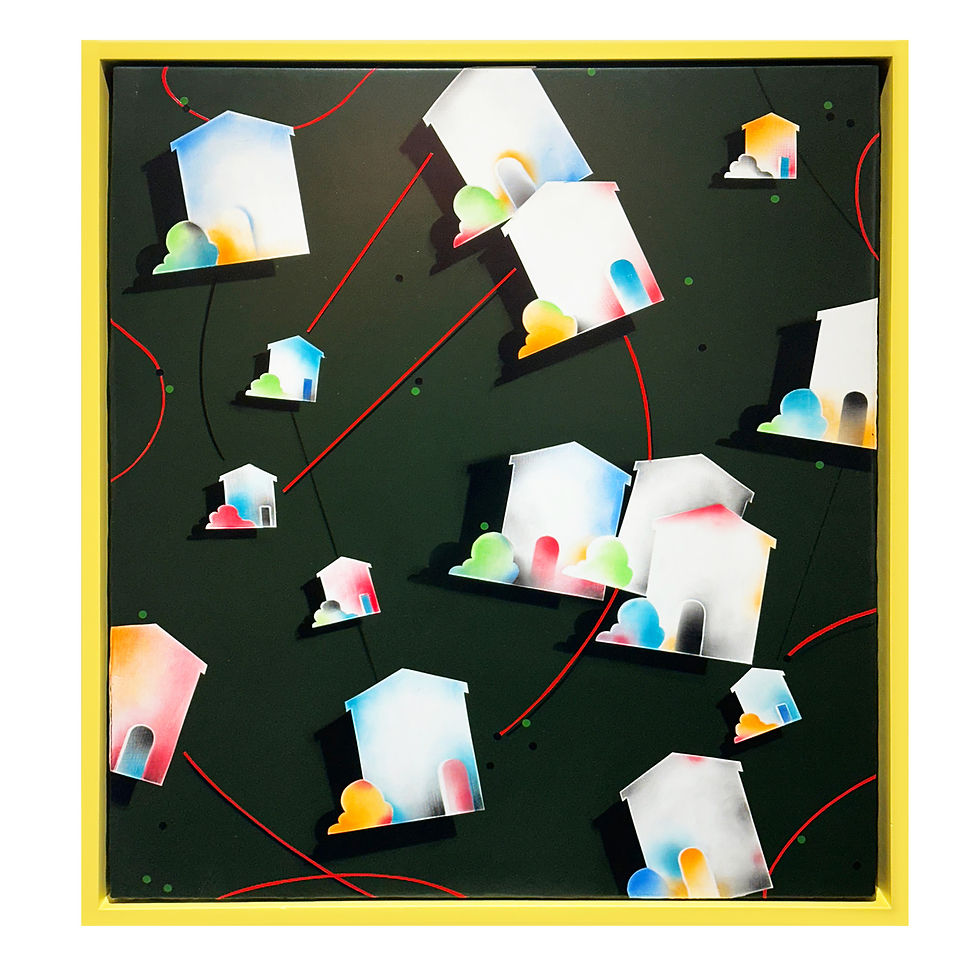
Evan Peltzman, We'll pay them back one day, 2025, Pastel, acrylic, paper and canvas on wood panel, 26.5 x 23.5 x 2.5 inches

Yena Park, On top of a snow covered mountain where the dead become the land, 2026, Oil on cotton, 24 x 30 in

Yena Park, Echoes of the Blue Green Mountain, 2026, Oil on cotton, 24 x 36 in

Yena Park, There were times I wished to see your ghost, 2026, Oil on cotton, 17.9 x 20.9 in

Yena Park, Deep Sleep, 2026, Oil on canvas, 17 x 20 in

Yena Park, And nothing ever happened, 2026, Oil on canvas, 15 x 12 in

Yena Park, Jia, 2024 Color pencil and burnt paper on paper, 11 x 8 in

Yena Park, Yannie, 2024 Color pencil and burnt paper on paper, 11 x 8 in

Yena Park, On the edge of last night, 2024, Color pencil on paper, 11 x 8 in

Yena Park, Last night on earth, 2024, Color pencil on paper, 11 x 8 in

Ruoxi Hua, Orion, 2024 Oil on panel, 18x10in
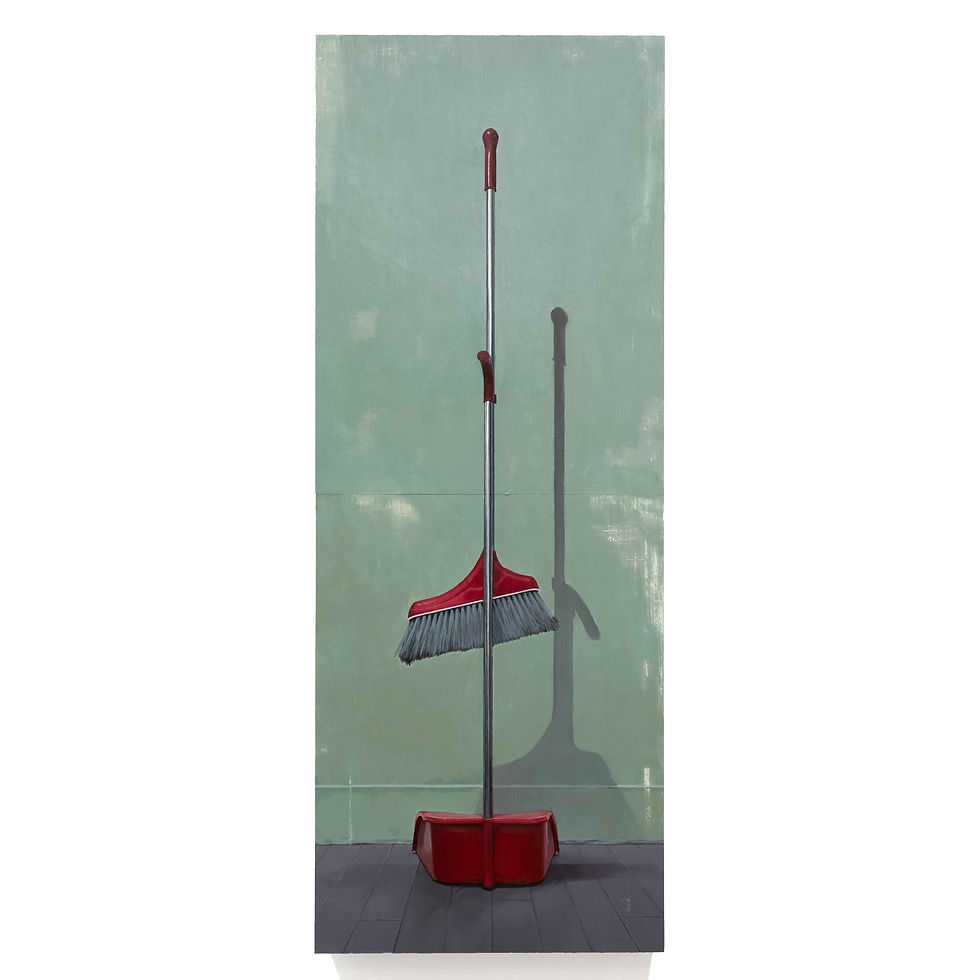
Ruoxi Hua, Dusty Corner FlyingV, 2024, Oil on jointed panels, 28x11in

Ruoxi Hua, Composition 001, 2025, Acrylic on paper, 10.5x13in

Moyan Sun, Observe, 2024, Oil pastel and wood, 9 x 8 in

Moyan Sun, Membrane of Restraint, 2024, Oil pastel on wood panel and yarn, 10 x 8 in

Moyan Sun, Arcs that bite the veil of seeing, 2024, Oil pastel on wood panel and plastic, 8 x 10 in

Moyan Sun, Membrane of Soft Defiance, 2024, Oil pastel on wood panel and yarn, 8 x 10 in


